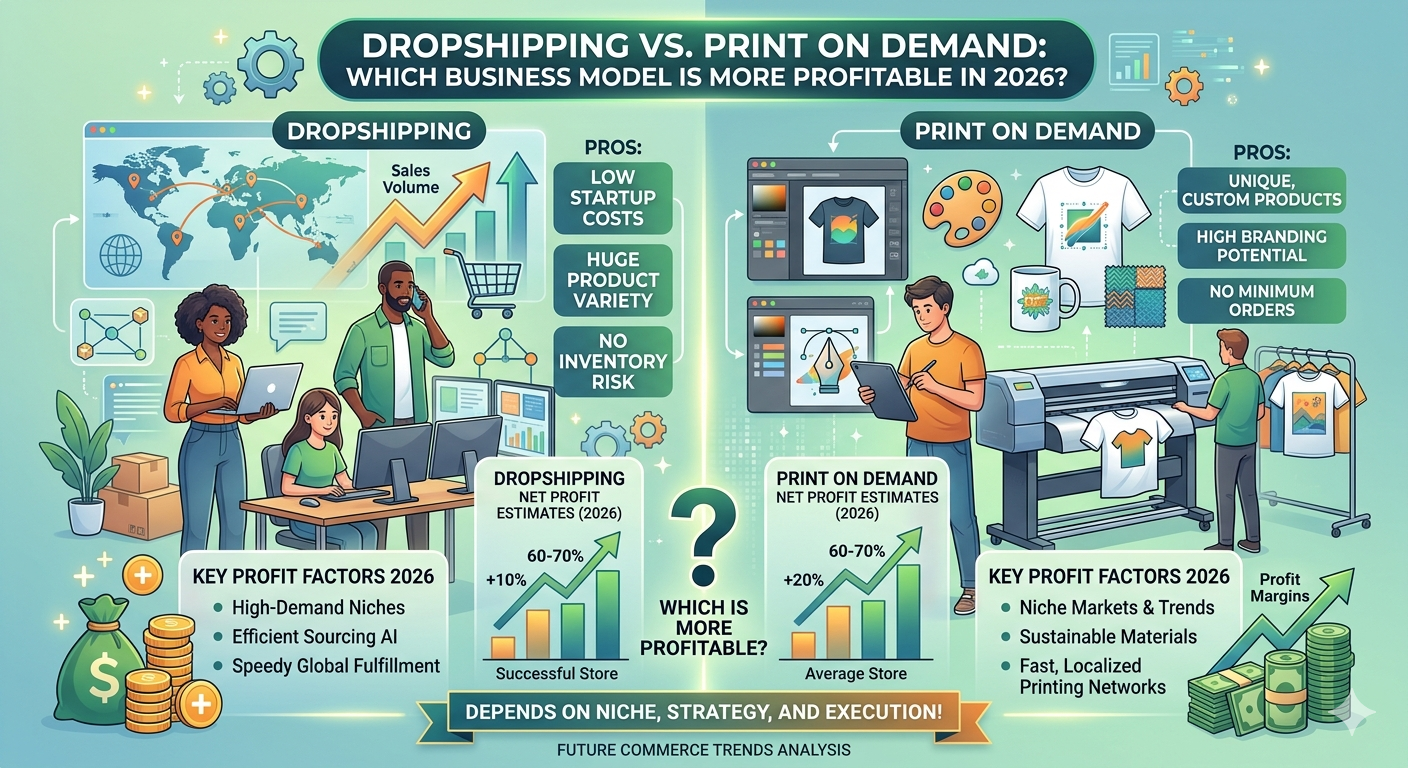
If you’re looking to start an online business, you’ve likely encountered two popular models: dropshipping and print on demand. Both allow you to sell without holding inventory, but they operate differently. So in the debate of dropshipping vs. print on demand, which is more profitable in 2026? Let’s compare.
What Is Dropshipping?
Dropshipping allows you to sell products that a third-party supplier holds and ships. You list products on your store, and when a customer orders, the supplier ships directly to them.
Pros:
- Wide variety of products
- No upfront inventory costs
- Easy to test new products
Cons:
- Lower profit margins (15–30%)
- Shipping times can be slow
- Less control over quality
What Is Print on Demand?
Print on demand (POD) is a subset of dropshipping where products are printed or customized only after an order is placed. Think t-shirts, mugs, phone cases with your designs.
Pros:
- No inventory risk
- Creative control over designs
- Higher perceived value
Cons:
- Limited product selection
- Lower margins on low-priced items
- Shipping can be slower

Profitability Comparison
| Factor | Dropshipping | Print on Demand |
|---|---|---|
| Typical Margin | 15–30% | 30–50% |
| Upfront Cost | Low | Low |
| Scalability | High (thousands of products) | Medium (design-dependent) |
| Best For | General stores, trending products | Branded merchandise, creative entrepreneurs |
Which Is More Profitable?
The answer depends on your strengths:
Choose dropshipping if:
- You’re skilled at finding trending products
- You understand paid advertising (Facebook, TikTok, Google)
- You want to scale quickly with a wide product range
Choose print on demand if:
- You have design skills or a strong brand identity
- You want higher per-item margins
- You prefer building a long-term brand over chasing trends
Can You Combine Both?
Yes! Many successful stores use both models. Use POD for branded merchandise and dropshipping for complementary products that you don’t design yourself.

Related Posts